

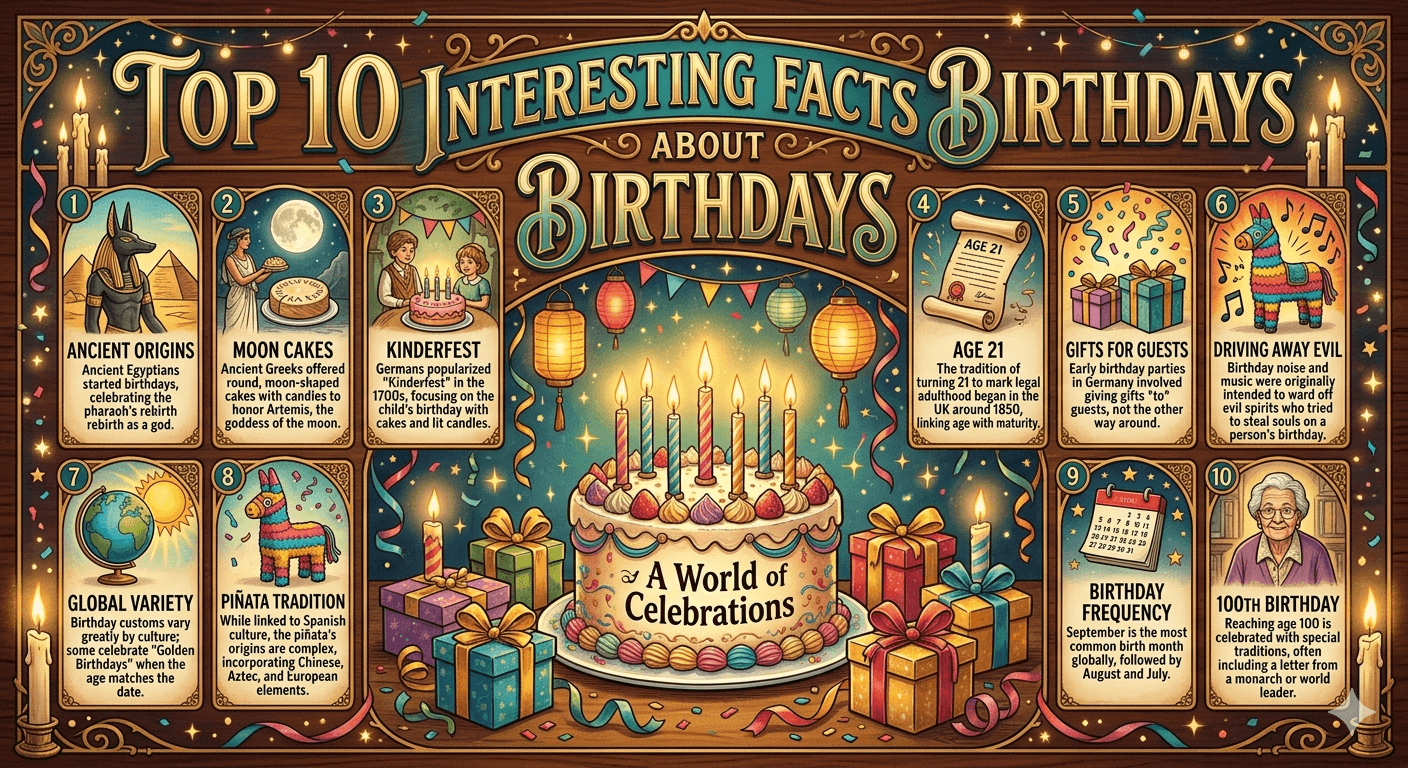
10 Interesting Facts About Birthdays
Birthday celebrations across the globe differ in a variety of ways, with each one having their own tradition. In Mexico celebrations for birthdays usually include a pinata, while in Russia it is customary to slap the ears of the birthday celebrant with good intention. The review on some of the Top 10 Interesting Facts About Birthdays illustrates how these customs have evolved, and they are delighting people.
The History of Birthday Celebrations.
Birthdays’ origins can be traced to the time of the ancient civilizations. Egyptians believed that on the day of coronation, the gods of Egypt were transformed into pharaohs, and that this would the day they celebrated their birthday. Romans established the custom to celebrate the birthday of people who were common. The events of the past gave the foundation for the current custom of celebrating birthdays. the top 10 Interesting Facts About Birthdays have become fascinating research of the history of different the different cultures.
Contemporary Birthday Party Ideas, and their significance.
Modern day birthday celebrations are typically marked by candles, cakes and celebrations. The tradition of blowing out candles can be believed to have started in Germany since candles were placed on the cake to symbolize the brightness of life. When looking at the top 10 Interesting Facts About Birthdays you can observe that these modern-day rituals have a significant historical context, since they’re both a private celebration and a part of the culture.
Amazing Birthday Traditions and Superstitions.
There are many birthday rituals and superstitions across various traditions. In China, it is believed that eating long noodles will help a person live longer, and in Jamaica hitting by flour is a common birthday joke. These traditions are among the top 10 Interesting Facts About Birthdays that offer an insight into how different cultures bring fun and meaning to birthday celebrations.
Here’s the top 10 most fascinating facts about birthdays.
| Interesting Birthday Fact | Why It’s Interesting |
| Ancient Egyptians connected birthdays to coronations and birthdays | The ideas for early birthdays were tied to royalties |
| Romans contributed to the popularity of birthday celebrations | The tradition was extended to everyday people. |
| Birthday candles could have started in Germany | The modern-day cake tradition is influenced by the contemporary cake |
| Wishing before blowing candles is an tradition that has been around for a long time | A practice that is still widespread |
| Cakes for birthdays were previously considered to be luxury items | Explores the evolution of celebrations in time. |
| The long noodles of China represent a long and healthy life | Birthdays can have symbolic significance |
| Jamaica is a birthday prank with a flour-throwing grin | Some traditions are fun and a bit bizarre. |
| Birthday customs differ worldwide | There are no two cultures that celebrate the same way |
| “Happy Birthday” “Happy Birthday” song is one of the most popular songs. | A worldwide birthday symbol |
| Birthday celebrations often reflect the local beliefs and superstitions as well as superstition. | Celebrations link culture and identity |
FAQs
Q1. How did birthday celebrations take place in the past?
Answer: Egyptian pharaohs celebrated their coronation as a birthday celebration and Romans commemorated the birth of their commoners as their birthdays by celebrating and baking.
Q2. What are the major variations in celebrations for birthdays?
Answer: Celebrations of birthdays differ across the world and have traditions that include Mexico using a pinata in order to signify the long life of a person, China using long noodles to symbolize long lives as well as Jamaica with the use of a flour-thrower to symbolize the prank of the day, are among the other cultural traditions.
Q3. What was the story behind birthday candles and cakes get their name?
Answer: The customs of birthday cakes and candles likely established in Germany and the United States, where people placed candles on cakes to symbolize the brightness of life. The tradition continues up to present-day birthday celebrations.