

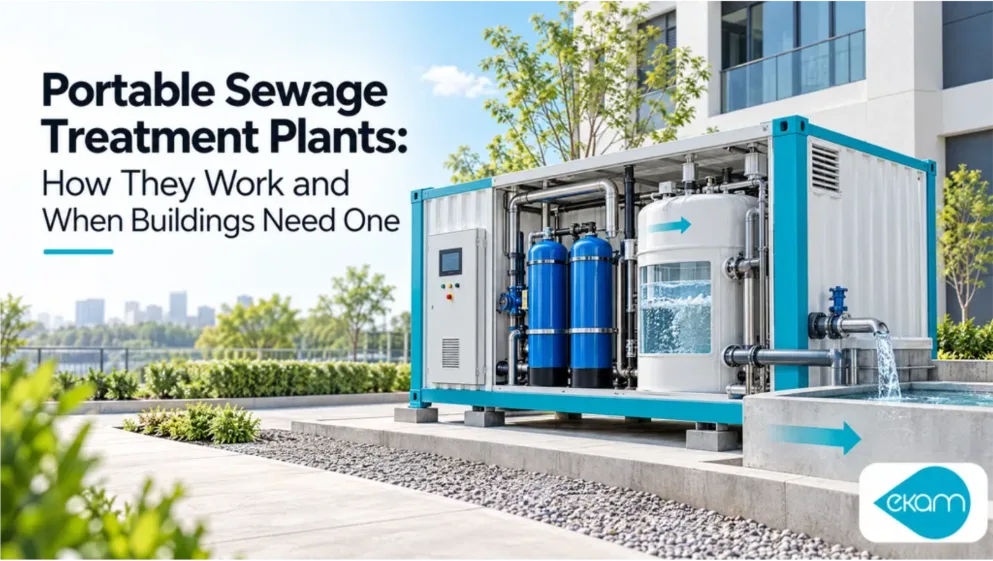
Portable Sewage Treatment Plants: How They Work and When Buildings Need One
Introduction
Buildings generate wastewater every day from toilets, washbasins, kitchens, showers and cleaning activities. Where sewage cannot be sent directly to a suitable municipal treatment network, a sewage treatment plant (STP) may be required. A portable or compact STP can offer a space-conscious option for selected sites, including construction projects, temporary facilities, remote properties and buildings where a conventional plant is difficult to accommodate. The right choice depends on wastewater volume, site conditions, local regulations and the quality required for reuse or discharge.
What is a portable sewage treatment plant?
A portable STP is a packaged or compact wastewater treatment system designed to be transported, installed and operated with less site-built infrastructure than some conventional plants. Depending on the model, treatment equipment may be arranged within a skid, tank, container or modular enclosure. ‘Portable’ does not mean that every unit can be moved while operating, or that it is suitable for every location. Capacity, power requirements, access for maintenance, foundation, ventilation and connection to sewer lines must be assessed before installation.
How does the treatment process work?
Most systems combine several treatment stages. Preliminary screening removes larger debris that could block pumps or damage equipment. Depending on the design, wastewater may then pass through equalisation or settling to manage flow and solids. Biological treatment uses microorganisms to break down biodegradable organic matter; some systems supply oxygen while others use different biological processes. Clarification separates biological solids from treated water. Filtration and disinfection may be added where the intended reuse or discharge standard requires them. Sludge is collected and managed separately.
How to decide whether a building needs one
Begin by confirming how wastewater is currently handled and what local rules require. A building connected to a compliant municipal sewer may not need its own STP, while a remote site, large campus or property with an applicable treatment requirement may need on-site treatment. Evaluate the number of users, peak occupancy, daily flow, seasonal variation and wastewater characteristics. A hotel, hospital, office campus and residential complex can produce very different wastewater streams even when their average occupancy appears similar.
Key planning considerations
Space is only one factor. The site needs safe access for delivery, installation, operation and maintenance. Confirm the availability and reliability of electricity, the location of inlet and outlet pipes, drainage levels, odour control, noise limits and access for sludge removal. Consider flood risk and local environmental conditions. Ask suppliers for process drawings, design capacity, expected effluent quality, power consumption, consumables, service intervals and warranty details. The proposal should explain what is included and what the building owner must provide.
Treated water reuse and conservation
Where regulations and water quality permit, treated wastewater may be reused for non-potable applications such as landscaping or toilet flushing. Reuse requires suitable treatment, appropriate plumbing separation, clear identification and ongoing water-quality checks. Treated water should never be assumed safe to drink. Buildings should compare the cost of treatment and reuse infrastructure with their water demand, freshwater costs and available alternatives. Ekam Eco Solutions’ guide to Water Conservation & Management in India discusses why water efficiency and responsible management matter across homes, businesses and institutions.
Operations matter as much as installation
A compact plant still needs trained operators or a defined service arrangement. Pumps, blowers, sensors, screens and dosing equipment require inspection. Operators should monitor flow, pH, dissolved oxygen where relevant, sludge condition and treated-water quality according to the process design. Sudden changes in wastewater loading, harmful chemicals or neglected equipment can disrupt biological treatment. Keep maintenance records and ensure that sludge is removed and handled through an appropriate route.
Questions to ask a supplier
Before purchasing, request evidence that the proposed system matches the required capacity and treatment objectives. Ask what happens during peak flow, power interruption or equipment failure. Clarify commissioning, operator training, spare-parts availability, after-sales service and sampling requirements. Check whether the system is designed for the actual wastewater type; industrial effluent may require pretreatment or a different process from domestic sewage. Compare whole-life operating costs rather than purchase price alone.
Conclusion
Portable sewage treatment plants can be useful where a building needs a compact, packaged wastewater solution, but they are not a one-size-fits-all answer. Proper assessment, compliant design, reliable operation and responsible sludge management are essential. For further information about compact STP planning and suitable applications, read Ekam Eco Solutions’ article on How a Portable Sewage Treatment Plant Works and explore the resources at Ekam Eco Solutions.
A practical implementation checklist
A useful next step is to assign an owner to each improvement and record the expected completion date. Document the current condition, the action taken and how the result will be checked. Where a change affects sanitation, wastewater, chemical handling or worker safety, consult the relevant technical guidance and applicable regulations before implementation. Pilot a change in one area, gather feedback from staff and users, and expand it only after confirming that it works as intended. This measured approach reduces guesswork, supports accountability and makes it easier to explain the value of the programme to management and stakeholders.