
Why Businesses Need a Connected Strategy for AI, Chatbots and IT Services?
Introduction
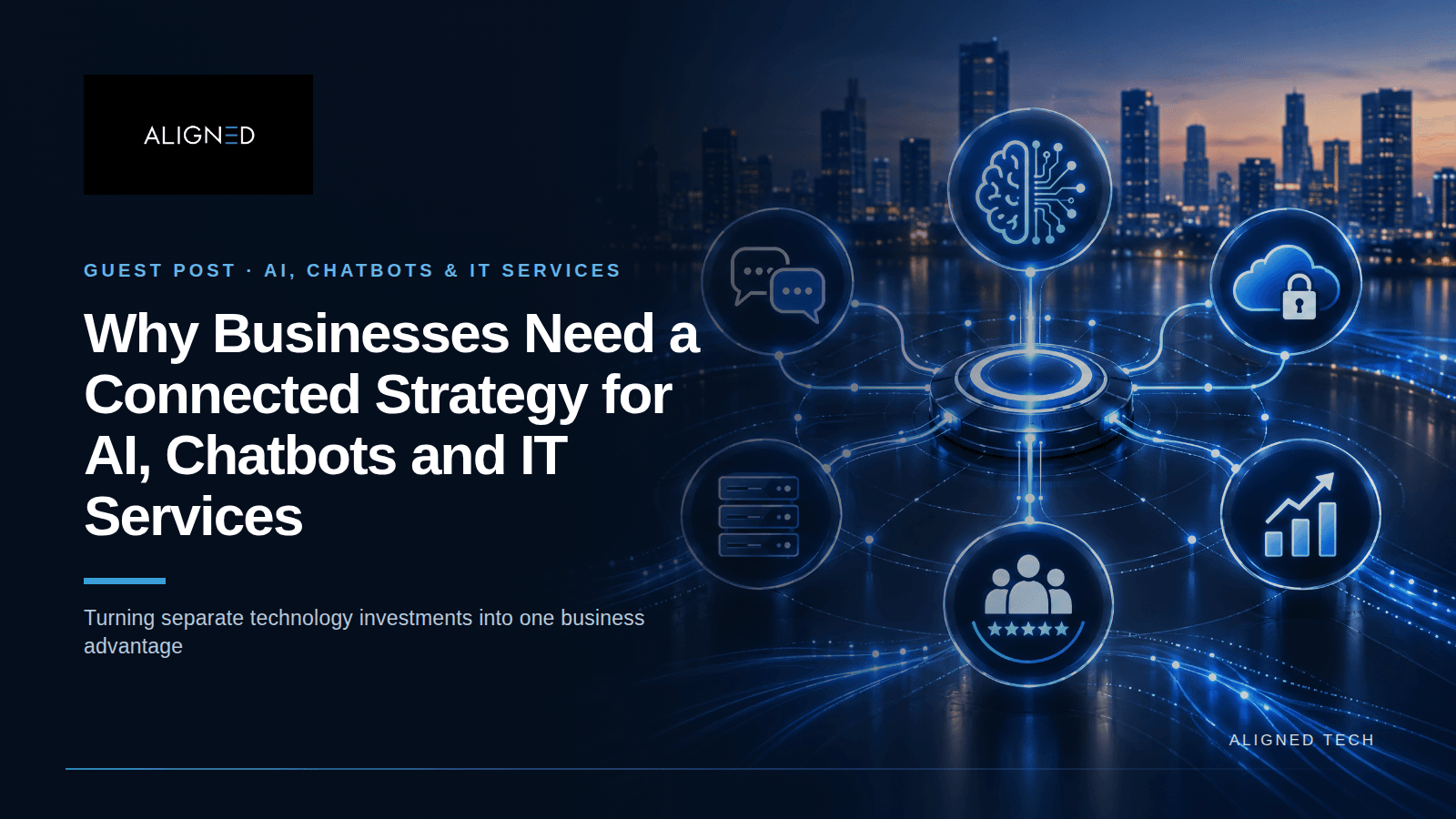
Businesses often adopt technology one project at a time: a chatbot for the website, a cloud platform for documents, a help desk for employee requests and a separate application for customer records. Each tool may solve a local problem, but disconnected systems can create duplicated data, manual handoffs and inconsistent experiences. A connected technology strategy looks at how IT services, cloud platforms and AI automation can work together to support business outcomes.
Start with the customer and employee journey
Before selecting tools, map how work happens. Consider how a new customer discovers the business, asks a question, becomes a lead and receives service. Then map internal processes such as employee onboarding, support requests, approvals and reporting. These journeys reveal where information is repeatedly entered, where delays occur and where automation could help. The aim is not to automate every step but to remove friction where it makes sense.
Chatbots as the front door to information
A chatbot can provide an accessible first point of contact for common questions. It may explain services, guide users to relevant information, capture contact details or route a request to the right team. For multilingual audiences, language quality is essential. Businesses serving Arabic-speaking customers should consider dialect, terminology and right-to-left presentation as part of the design. Aligned Tech discusses these considerations in its guide to Arabic chatbots in Qatar.
AI automation can connect the steps
A chatbot primarily communicates with a user, while an automation workflow can move information between systems and trigger approved actions. For example, a customer enquiry might be captured by a chatbot, added to a CRM, assigned to a sales representative and followed by a notification. Each step should have clear rules, permissions and error handling. More advanced AI agents can select tools and perform multi-step tasks, but they require careful boundaries and monitoring.
Cloud and IT foundations support automation
Automated workflows depend on reliable applications, identity management, connectivity and data access. Cloud platforms can make systems available to distributed teams, while IT support helps maintain devices, networks and business applications. If these foundations are unreliable, automation may simply make existing problems happen faster. A connected strategy therefore includes maintenance, security, backup and support alongside AI development.
Security and governance across the environment
When systems exchange information, organisations must understand what data is shared and who can access it. Use least-privilege permissions, secure authentication, logging and documented retention rules. Sensitive actions may require human approval. Businesses should also define what happens when an integration fails, an AI assistant is uncertain or a customer requests a human. Governance should be practical and proportionate to the risk of each workflow.
Measure outcomes rather than activity
The number of automated conversations is not, by itself, proof of business value. Better measures include reduced handling time, fewer repeated data entries, faster lead response, improved first-contact resolution and employee satisfaction. Track exceptions as well as successful completions. Regular reviews can reveal where a workflow needs better data, clearer prompts or a different handover process.
Build incrementally
A connected strategy does not require a large transformation all at once. Select one workflow with a clear owner and measurable problem. Document the current process, define the desired outcome, implement a limited solution and test it with real users. Once the workflow is stable, expand to related tasks. This approach reduces risk and helps the organisation build internal confidence.
Conclusion
AI, chatbots, cloud services and IT support create more value when they are designed as parts of one operating environment. Businesses should begin with real user needs, connect systems carefully, protect information and measure outcomes. Aligned Tech‘s broader technology offering brings IT, cloud, AI and development capabilities together; learn more at Aligned Tech